















Chargeback.io FAQs
Find out how Chargeback.io works, what it costs, and what setup and ongoing management involve.
General
What do I need to create a Chargeback.io account?
Have these ready before you start: your business website URL, your business name, a valid credit card, at least one billing descriptor, and your RDR IDs (two ARNs, or BINs and CAID). Payment processor API keys are optional, and you will fund your balance before alerts begin. Accurate business and processor details matter, because incorrect details can cause missed alerts or lost coverage.
Which integrations do you support?
We support Stripe, Shopify, Braintree, Chargebee, Recurly, Adyen, Authorize.net, NMI, Airwallex, Maverick Payments and Next Commerce. If your processor is not listed you can still receive alerts and refund them manually, and you can request a new processor or app integration.
Can I receive alerts without connecting a payment processor?
Yes. Without any integration you still receive alerts, but Ethoca and CDRN alerts must then be refunded manually in your processor. Connect a processor if you want automatic refunds. You can also keep an integration connected with auto-refund turned off, in which case we still search your processor for the matching transaction and give you a direct link to it.
How fast until we are live?
Once your account is set up correctly, each billing descriptor moves from Pending to Active within roughly 12 hours for Ethoca Alerts and CDRN, and within 7 business days for RDR. American Express and Discover coverage takes about 4 weeks. If Verifi has an enrollment backlog, RDR can take up to 14 days. These timelines are set by the alert networks, not by us.
How is my data protected?
We keep your data safe through organization-wide and technical security measures, described in our Privacy Policy. We collect your name, contact preferences, billing address, the card you use to pay for alerts, and the password you set for your account. Processor API credentials are only needed if you opt into automatic refunds with Ethoca or CDRN, and we do not save them. You can disconnect a payment processor at any time, or use manual refunds only and never share processor access.
Can I add my team to the account?
Yes. You can add team members to your organization, and you can add multiple business accounts under one organization if you run more than one brand or processor setup.
Is there an API?
Yes. You can connect directly to the Chargeback.io API, and you can also connect an AI assistant through our MCP server.
Can I switch from another alert provider?
Yes. You can transfer your alert service to Chargeback.io, and if you ever want to leave you can transfer it back out. Descriptors have to be unenrolled from your previous provider before they can activate with us.
Prevent
What is a chargeback prevention alert?
An alert is an early warning that a cardholder has disputed a transaction, delivered by Ethoca or Verifi before the dispute becomes a formal chargeback. If the cardholder's bank participates in a supported alert network and you refund before the deadline, the pre-dispute is resolved and never becomes a chargeback.
What is the difference between Ethoca, RDR and CDRN?
Ethoca costs $29 per alert, activates in about 12 hours, and gives strong global coverage (around 95% Mastercard, 50% Visa) with manual or automatic refunds. RDR costs $15 per alert, takes 7 or more business days to enroll, covers around 97% of Visa, and always refunds automatically. CDRN costs $15 per alert, activates in about 12 hours, and is US only. Most merchants enroll in Ethoca and RDR; choose CDRN only if you cannot enroll in RDR.
When do alerts start arriving?
Once a billing descriptor is Active you receive alerts for disputes filed after the activation date. You will not receive alerts for disputes filed before that date, so if an alert seems to be missing, check the activation date first. The transaction date alone does not tell you when the dispute was filed.
How do refunds work?
With an integration connected, we match the alert to a transaction using your auto-refund threshold and refund it for you. If no match is found, or you have no integration, find the transaction in your processor and refund it before the deadline shown in your dashboard, email or Slack. RDR alerts are always refunded automatically by Verifi.
Are American Express and Discover covered?
Partly. American Express is covered for reason code F29 (card not present) and Discover for UA02 (card-not-present fraud). Additional Amex and Discover coverage for Ethoca can be added and takes around 4 weeks to activate.
Why am I not receiving alerts?
The most common causes are a billing descriptor that is not yet Active, a dispute filed before your activation date, a cardholder bank that does not participate in the network, or a billing descriptor too similar to another business, which can route the alert elsewhere. Non-card methods such as PayPal Wallet, Affirm, Amazon Pay, Cash App Pay and Klarna are not covered by any alert network.
Can a chargeback still happen after I refund?
Occasionally, yes. A refund issued after the deadline, or after the issuing bank has already advanced the dispute, may not stop the chargeback. RDR cases can also still appear in your processor as disputes even though they were resolved through the alert network.
Will I get duplicate alerts for the same dispute?
It can happen if you are enrolled in both Ethoca and CDRN, or both CDRN and RDR. When our system detects a duplicate it credits it automatically, so you do not need to file a request. Avoiding CDRN unless you genuinely cannot enroll in RDR reduces the risk.
Deflect
What does Chargeback Deflect do?
Deflect shares your transaction and order detail with the cardholder's bank at the moment a dispute is being raised, so the cardholder can recognise the purchase and withdraw it before it becomes a chargeback. It works earlier in the dispute lifecycle than evidence submission, which happens only after a chargeback already exists.
How is Deflect different from Prevent?
Prevent tells you a dispute is coming so you can refund it. Deflect works to stop the dispute being filed at all by surfacing order detail to the cardholder and their bank. They address different points in the same timeline and are designed to be used together.
Do I need Deflect if I already have Prevent?
They cover different gaps. Prevent only fires alerts when the cardholder's bank participates in Ethoca or Verifi, and every alert you refund still costs you the refund and the alert fee. Deflect aims to remove the dispute earlier, so fewer cases reach the alert stage at all.
Does Deflect require a separate integration?
Deflect uses the same processor connection and billing descriptors as the rest of your account, so if you have already connected a processor there is nothing new to wire up. Speak to our team about enabling it on your account.
Health
Why should I monitor both fraud and chargeback rates?
They measure two different problems. Fraud rate shows how much fraud is appearing in your payments, including early fraud warnings such as Visa TC40 and Mastercard SAFE reports that never became disputes. Chargeback ratio shows how many successful payments turned into disputes, fraud and non-fraud alike. You can improve one and still have trouble with the other, so each needs separate attention.
Can my fraud rate rise even if I prevent the chargeback?
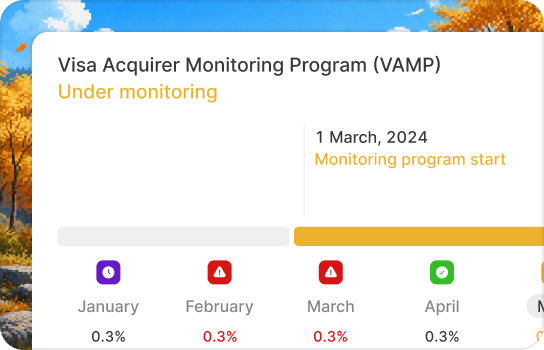
Yes. An early fraud warning still counts toward your fraud rate even when no chargeback follows. That can expose you to the Visa Acquirer Monitoring Program (VAMP), fraud-specific monitoring from other networks, and processor restrictions, which is why prevention alone is not the whole picture.
How is VAMP calculated?
Visa's VAMP ratio is calculated as TC40s plus TC15s divided by total settled transactions, which means fraud reports and disputes both feed the same number.
Why can my chargeback rate stay high after refunds?
It can look that way. Most processors, including Stripe, display RDR cases as disputes even though they were resolved through the alert network, so your processor-reported rate and your true prevented-dispute picture can differ. Health shows both so you can see what your acquirer sees.
What does the dashboard show me?
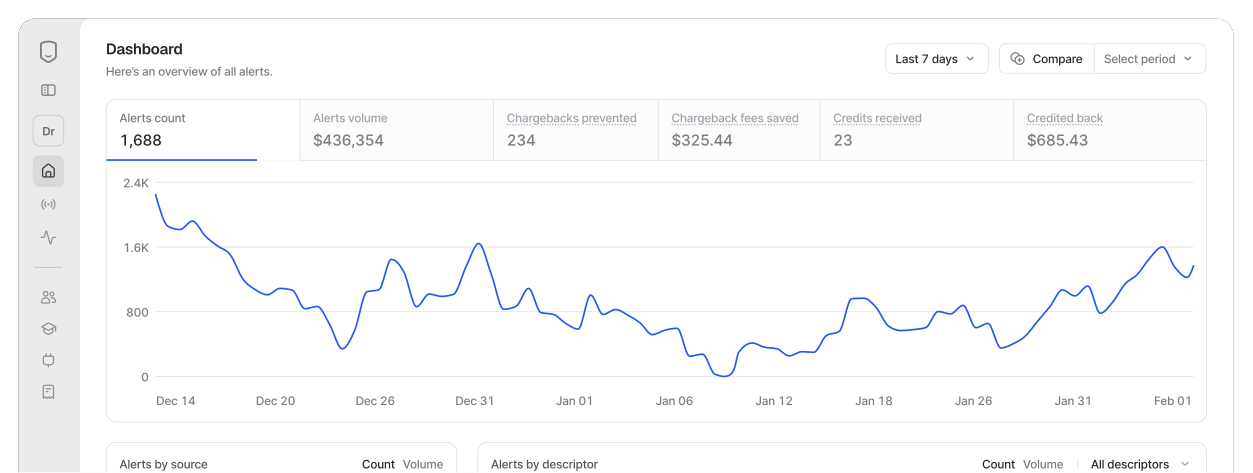
Your dashboard brings together alerts received, refunds issued, spend and the health of each billing descriptor, so you can see which descriptors are active, which need attention, and how your prevention is performing over time.
Pricing
How much do chargeback prevention alerts cost?
You pay per alert received: $15 for RDR, $29 for Ethoca and $15 for CDRN. On top of that you cover the cost of refunding your customer's order. Because the dispute is prevented, you avoid your processor's dispute fees. If you have high chargeback volume, contact Sales about volume-based pricing.
How does billing work?
Billing runs on a prepaid Balance rather than invoices. You add funds up front and each alert is deducted as it arrives. This removes billing cycles and avoids failed payments or accidental deactivation from an outdated card.
Do I choose which alert network charges me?
No. You are charged for whichever network delivered the alert, and we do not choose that. If the cardholder's bank participates in Ethoca but not RDR, Ethoca sends the alert and you are charged $29. If that bank participates in RDR instead, Verifi sends it and you are charged $15.
What happens if my balance runs low?
When your Balance reaches your Critical threshold we automatically charge your saved payment method and top it back up to your Recommended threshold, so your alert service is not interrupted. If your Balance falls to 30% of your Minimum, your account enters a deactivation risk state.
Is my balance refundable?
Yes. Top-ups are refundable up to $10,000 once all descriptors are fully disenrolled from every alert network across all of your accounts. Contact support once you are fully unenrolled and we will process it.
Do I get credited for bad alerts?
Yes. Alerts with the statuses Not Found, Expired, Already a Chargeback, Failed Transaction and Previously Refunded can be credited through a Manual Credit Request, applied to your account balance. Duplicates are credited automatically. For RDR alerts specifically, credits are only accepted when the alert is a duplicate.
See your chargeback results
Track chargebacks prevented and fees saved in your Chargeback.io dashboard.
Get started